The short answer
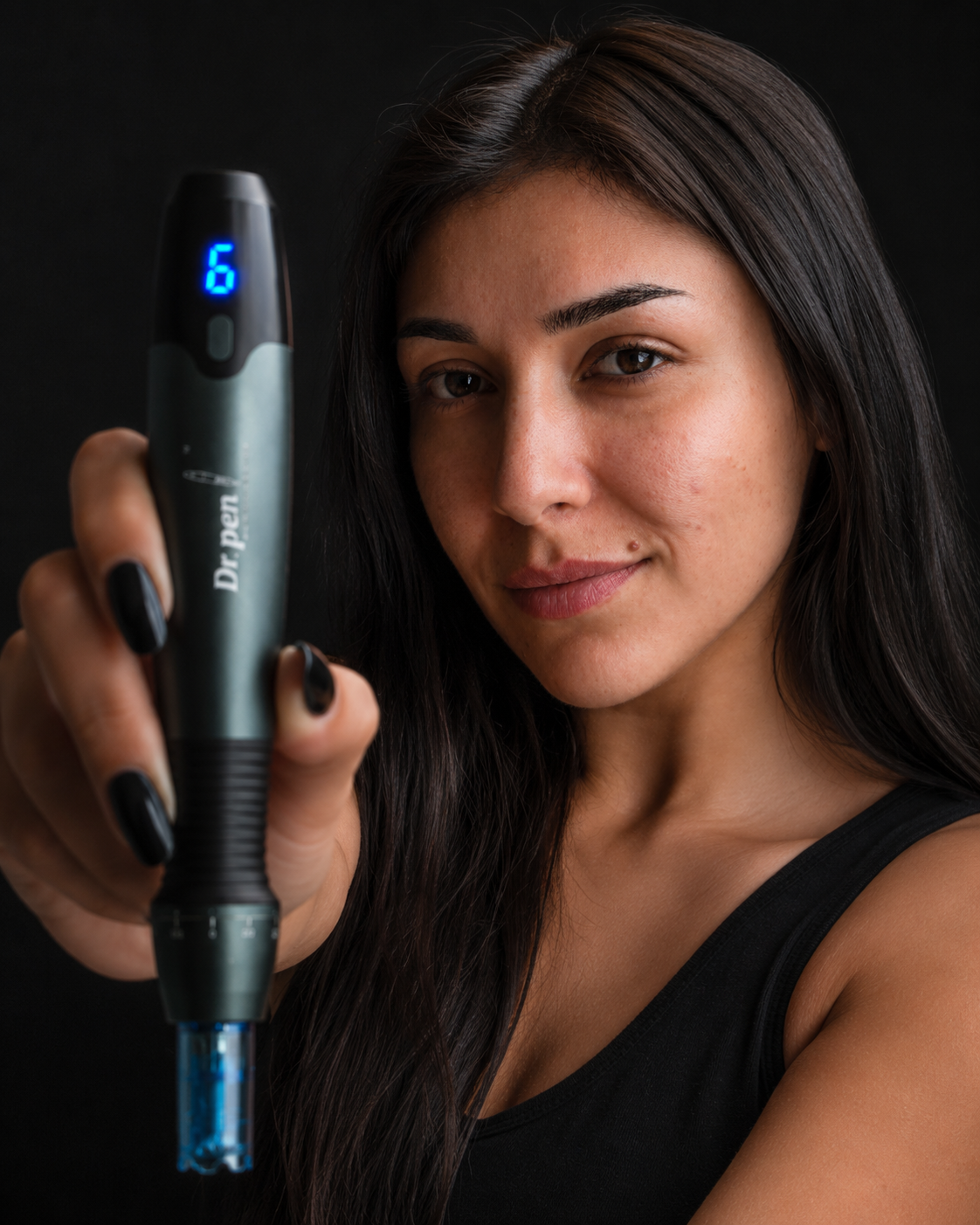
The Dr. Pen A20 is the device we restock most often and the one most of our customers now choose. Its real advantage is not speed or power — it is that the depth control uses nine fixed steps instead of a continuous dial, so you can repeat the same setting exactly, session after session. If you are treating something over months rather than weeks, that is worth more than any figure on the box.
We have been selling Dr. Pen devices for seven years, and the A20 changed what our order book looks like. It arrived as the newest professional pen in the range and quickly became the device we ship and restock more than any other — more than the rest of the catalogue put together.
This is not a review written from a spec sheet. It is written from selling the thing: what people ask before they buy it, what they come back for, and where it genuinely is not the right answer. Where we could not verify a number ourselves, we have left it out rather than guess.
What the A20 actually is
The A20 is Dr. Pen's professional-tier microneedling pen. Physically it is a cordless handpiece with an LED digital display, a 700mAh battery charged over Type-C, and its own charging dock. It ships with the handpiece, the dock, two 14-pin cartridges, a Type-C cable and adapter, ten disposable protective sleeves and a user guide.
The specification that matters:
| Feature | A20 | Why it matters |
|---|---|---|
| Needle depth | 0–2.0mm in nine fixed 0.25mm steps | The whole argument for the device. Every other model uses a continuous dial you set by eye. |
| Motion | AVOS vertical oscillation | Needles travel straight in and out rather than at an angle, which reduces drag across the skin. |
| Speed | 6 levels, up to 7,700 RPM | Affects glide and comfort, not depth. See the note on speed below. |
| Battery | 700mAh, Type-C, charging dock | Cordless throughout a session. The dock matters more than it sounds if you treat several people. |
| Display | LED digital | Depth and speed shown as numbers rather than read off a ring. |
| Cartridge fitting | Three-lock connection, anti-backflow interface | Cartridge seats securely and serum is less likely to travel back into the housing. |
| Clearance | FDA 510(k) cleared | Worth knowing, and worth understanding correctly — see the FAQ. |
Current pricing is on the A20 product page.
The nine steps are the point
If you take one thing from this review, take this.
Almost every microneedling pen — including every other Dr. Pen model we stock — sets depth with a continuous ring. You turn it until the marking lines up somewhere near the number you want. That works fine for a single session. It stops working when you are treating something across months.
Say you are working on scarring at 1.25mm. On a dial, session two might land at 1.2mm and session three at 1.35mm, and you would have no way of knowing. Each session is then a slightly different treatment, and if the results are uneven you cannot tell whether the depth or something else caused it. On the A20 you select step five, and step five is the same distance every time.
The nine steps run from 0 to 2.0mm in 0.25mm increments. Note the ceiling: 2.0mm, not the 2.5mm several cheaper models offer. That is not a shortcoming for facial work — 2.5mm is a body depth for thick skin such as stretch marks on the abdomen or thighs. For faces, 2.0mm is already the deep end. But if body work is your main use, it is worth knowing before you buy.
Our needle depth guide gives a starting depth for each concern, and every one of those numbers lands cleanly on an A20 step.
What AVOS actually means
AVOS stands for vertical oscillation. In practice it means the needles travel straight in and straight out, perpendicular to the skin, rather than moving with any lateral component.
The practical difference is drag. A needle entering at an angle drags slightly as it withdraws, which is what produces the fine linear marks people sometimes call tracking. Vertical motion reduces that, and it is most noticeable at higher depths where the needles are travelling further.
It is not magic and it does not replace technique — holding the pen perpendicular and keeping it moving still matters, as our step-by-step guide covers. But it does make the device more forgiving at depth than an older pen.
The cartridge platform
This is the part people underestimate, and it is worth more thought than the handpiece itself. Cartridges are single use, so you will keep buying them for as long as you own the pen. Over two years of regular treatment, the cartridges cost more than the device did.
The A20 has the widest cartridge choice of anything we stock — seven options:
- 12-pin and 14-pin — targeted work on smaller areas. These are the two our A20 customers reorder most.
- 18-pin and 24-pin — a middle ground, more coverage per pass.
- 36-pin and 42-pin — larger surface areas, pressure spread more gently.
- Nano square — silicone-tipped, surface only. For serum absorption and maintenance between deeper sessions.
Something worth noticing there: the lower pin counts outsell the higher ones by a clear margin among our A20 buyers. If your instinct was that more needles must be better, our reorder pattern says most people disagree once they have used the device. Lower counts concentrate the work where it is needed — scars, smaller areas, targeted lines.
A20 cartridges are made for the A20. Dr. Pen builds each cartridge to match a specific handpiece, so cartridges from an M8, M8S or A11 will not fit, and A20 cartridges will not fit those. If you are ever unsure which cartridges suit your pen, send us a photo and we will point you to the right ones. Our cartridge guide covers every platform we stock.
What speed does and does not do
The A20 offers six speed levels up to 7,700 RPM, and this is a number people put too much weight on.
Speed does not change how deep the needles go — the depth setting does that, exclusively. What speed changes is how smoothly the pen glides and how it feels. A faster oscillation means less resistance as you move across the skin, which matters for comfort and for even coverage.
Here is the honest context: the Dr. Pen M8 runs a motor up to 18,000 RPM — more than twice the A20's figure — and it is our lowest-priced device. If RPM were a quality ranking, the cheapest pen in the range would be the best one. It is not a ranking. Different motor designs and different motions produce different numbers, and comparing RPM across them tells you very little.
Who the A20 is for
Choose it if you treat clients and need settings you can record and repeat; if you are working on scarring or pigmentation over a course of months where consistency between sessions is the whole point; or if you want the widest cartridge range so one device covers targeted and broad-area work.
Consider something else if this is your first pen and you are treating your own face occasionally. The A20 is several times the price of the M8, and the M8 will do that job well — with cheaper cartridges to feed it. There is no shame in the entry route; most people who end up with an A20 got there because they were treating something specific, not because they wanted the best device on the shelf.
Also consider something else if your main use is body work on thick skin. The A20 tops out at 2.0mm, and stretch mark treatment often calls for more. The M8 and several other models reach 2.5mm.
And if hair loss is your reason for buying, the M8S is the model most often bought for scalp work. The A20 is used for it too, with 12-pin or 14-pin cartridges, but the M8S is the more common choice at a lower price.
How it sits against the rest of the range
| Model | Depth control | Max depth | Best suited to |
|---|---|---|---|
| A20 | 9 fixed steps | 2.0mm | Professional use, scars, repeatable protocols |
| M9 | Continuous dial | 2.5mm | General professional use |
| A11 | Continuous dial | 2.5mm | General professional use |
| M8S | Continuous dial | 2.5mm | Hair loss and scalp work |
| M8 | Continuous dial | 2.5mm | Best value, deep and body work |
The full model comparison puts every device we sell side by side, and our device guide walks through the decision if you are still weighing options.
What we have learned from selling it
Three things, none of which appear on a spec sheet.
People buy it for one specific problem. Almost nobody buys an A20 as a general skincare purchase. They buy it because of scarring, or because they are treating clients, or because they have already used a cheaper pen and want more control. That is worth knowing if you are trying to decide — if you do not have a specific reason, the honest answer is probably that you do not need it yet.
The cartridge reorders tell the real story. The 12-pin and 14-pin lead comfortably. People are doing targeted work, not treating whole faces at maximum coverage.
The questions we get before purchase are almost always about cartridges, not the device. Will my old ones fit, which pin count do I need, how many will I get through. That tells you where the actual long-term commitment sits — and it is why we would rather you pick a platform deliberately than pick a handpiece and discover the platform afterwards.
Buying a genuine A20
Counterfeit Dr. Pen devices exist and are not something you want against your skin. Genuine units can be authenticated through Dr. Pen's manufacturer security-verification system using the code on the box. If a listing sits far below what authorised stockists charge, it is worth checking before you buy.
Frequently asked questions
Is the Dr. Pen A20 FDA approved?
The A20 holds FDA 510(k) clearance. Clearance and approval are different things: clearance means the device was shown to be substantially equivalent to an existing legally marketed device, which is the pathway most microneedling pens follow. It is a meaningful regulatory status, and it is not the same as the pre-market approval used for higher-risk devices.
What is the maximum needle depth on the A20?
2.0mm, reached in nine fixed steps of 0.25mm. Several other Dr. Pen models reach 2.5mm using a continuous dial, which suits thick body skin better.
Can I use M8 or A11 cartridges with the A20?
No. Dr. Pen builds cartridges to match a specific handpiece, so the A20 takes A20 cartridges only. If you are unsure what you have, send us a photo and we will confirm it.
Which A20 cartridge should I start with?
The device ships with two 14-pin cartridges, which suit most facial work. For targeted scar work the 12-pin is the more common choice; for larger areas the 36-pin or 42-pin cover more per pass.
Is the A20 suitable for a beginner?
It works perfectly well for a beginner, but it is more device than a first-time home user usually needs. If you are treating your own face occasionally, the M8 does that job at a fraction of the price with cheaper cartridges.
How long does the A20 battery last?
The 700mAh battery is designed to run through a full session cordless and charges over Type-C, with a charging dock included. If you are treating several people in a row, the dock is the part you will appreciate.
Can the A20 be used for hair loss?
Yes, generally with 12-pin or 14-pin cartridges. The M8S is the model more commonly bought for scalp work, at a lower price, so it is worth comparing the two if hair loss is your main reason for buying.
How often should I use the A20?
That depends on depth rather than device. Shallow work suits a frequent rhythm; deeper settings need weeks between sessions. Our depth guide gives the frequency for each setting.
Please speak with your doctor before purchasing any Dr. Pen product. This content is not intended to substitute for the advice of a qualified physician, pharmacist or other licensed healthcare professional.