
The short answer
Choose the A20 if you want repeatable, locked-in depth for facial work, scarring and textural concerns. Choose the M8S if your main focus is the scalp and hair loss, or if you want a capable pen at a price that sits well below the A20.
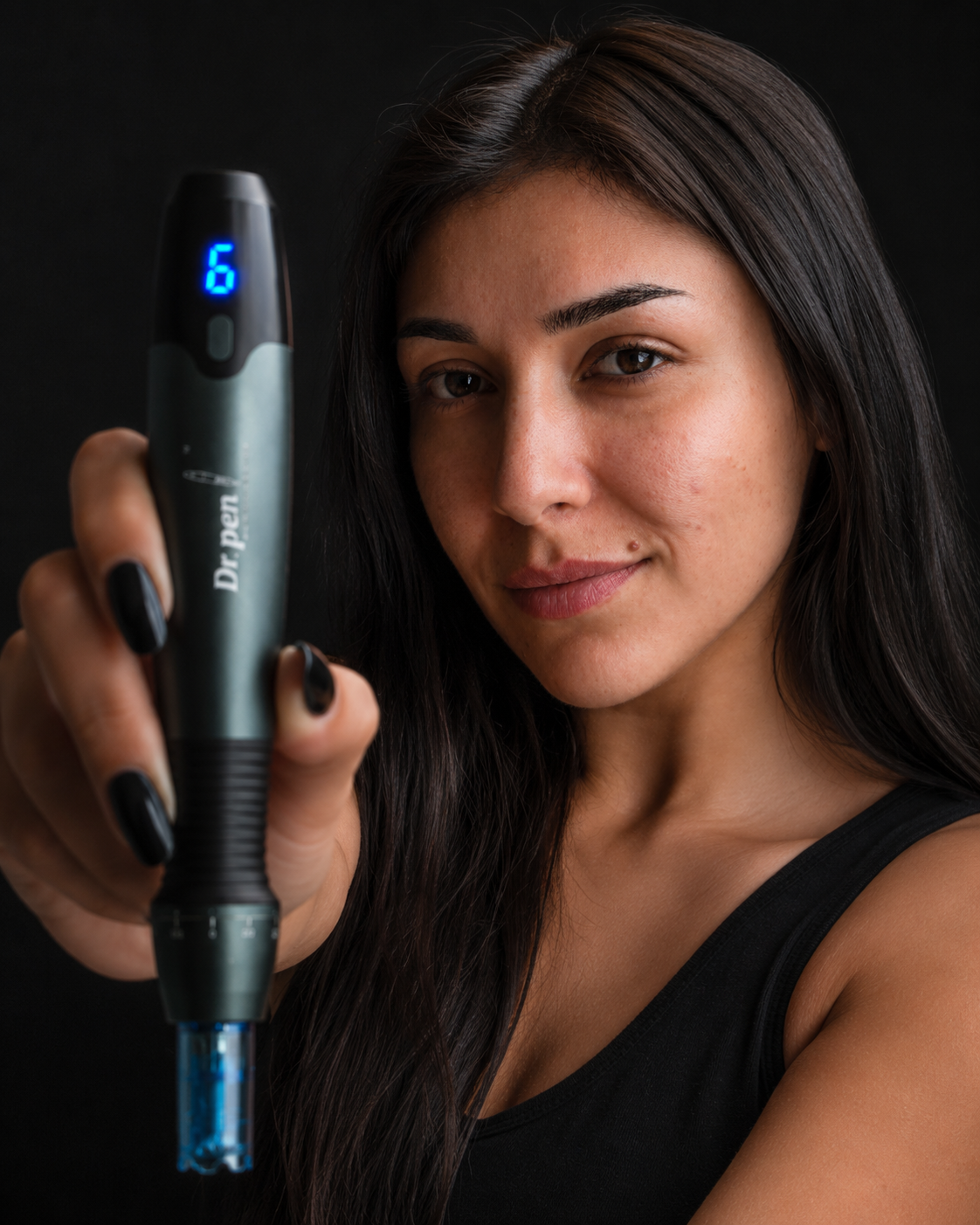
These two pens come up in the same conversation almost every week. They sit at different points in the Dr. Pen range, they are built around different design priorities, and they are the two models people most often narrow down to once they have ruled everything else out. We have been an authorised Dr. Pen stockist for seven years and we sell both, so we have no reason to steer you towards one over the other. What follows is a straight comparison of where each one earns its place.
In short: the A20 is the more refined instrument and the M8S is the more targeted one. If that already tells you which way you are leaning, the sections below will confirm it.
Dr. Pen A20 vs M8S: side by side
| Feature | Dr. Pen A20 | Dr. Pen M8S |
|---|---|---|
| Depth range | 0–2.0mm | 0–2.5mm |
| Depth adjustment | 9 fixed steps in 0.25mm increments | Continuous dial |
| Needle motion | AVOS vertical oscillation | Vertical oscillation |
| Speed levels | 6, up to 7,700 RPM | 6 (top RPM not published) |
| Battery | 700mAh, Type-C, charging dock | Not published |
| Display | LED digital display | Not published |
| Cartridge connection | Three-lock connection with anti-backflow interface | Cartridges with an improved anti-backflow design |
| Cartridge options | 12, 14, 18, 24, 36, 42 pin and nano square | M8S range, a separate platform |
| Regulatory | FDA 510(k) cleared | Not published |
| Most often bought for | Face, scarring, texture | Scalp and hair loss |
| Price position | Flagship | Sits well below the A20 |
Where a row reads “not published”, Dr. Pen does not publish that figure for the M8S and we would rather leave it blank than estimate. Current pricing is on each product page.
Depth control: nine fixed steps against a continuous dial
This is the biggest practical difference between the two pens, and it often decides the purchase.
The A20 moves through nine fixed depth positions, from 0 to 2.0mm in 0.25mm increments. Each one clicks into place. There is no in-between setting, which sounds like a limitation until you have run a course of treatments over several months. Fixed steps mean that the 1.0mm you set in January is the same 1.0mm you set in June. You are not judging a dial by eye, you are selecting a position, and the LED display confirms what you have chosen before the pen touches your skin.
The M8S uses a continuous dial across a wider 0 to 2.5mm range. That gives finer granularity in theory — you can sit at 1.3mm if you want to — but it asks a little more of you to return to exactly the same place next time. In practice most people settle on a handful of working depths, and that works perfectly well.
Why repeatability matters over a months-long course. Microneedling results are cumulative. You are building a consistent stimulus over many sessions, and the only way to judge whether a depth is working for you is to hold it steady long enough to see. If depth drifts by a quarter of a millimetre between sessions without you noticing, you lose the ability to attribute a change to anything in particular. That is what the A20's fixed steps buy you: not more precision in the abstract, but the ability to reproduce a session.
If you would like to see how those nine positions map onto different areas and concerns, our guide to A20 depth settings walks through them, and what size needles you need for microneedling covers the same ground more generally.
Maximum depth: 2.0mm against 2.5mm
The A20 stops at 2.0mm. The M8S reaches 2.5mm. For facial work this difference is largely academic, because facial protocols rarely call for anything approaching 2.0mm in the first place, and the thinner areas of the face are treated far shallower than that.
Where the extra half-millimetre becomes relevant is body work. Thicker skin on the back, thighs, abdomen and upper arms can call for deeper settings than the face ever will, and if that is a significant part of what you plan to do, the M8S gives you headroom the A20 does not. This is a genuine reason to prefer the M8S, not a footnote in the A20's favour.
It is equally worth saying that deeper is not better: depth should be matched to the area and the concern, and most people never use the top of either pen's range.
Why the M8S is the model most often bought for scalp work
The M8S is, by some margin, the pen chosen most often for scalp and hair-loss routines. There is a specific design reason for that, and it is worth explaining properly because it is frequently described inaccurately elsewhere.
Scalp work is done at an angle. You are working around and between hair, holding the pen tilted rather than flat against the skin, and you are usually applying a liquid serum as you go. That combination — angled handpiece plus fluid — is the situation in which serum is most likely to travel back up into the cartridge. M8S cartridges are built with an improved anti-backflow design that handles serum well in exactly that orientation, which is why the model has become the default recommendation for scalp routines.
To be precise about this: the A20 also has an anti-backflow interface as part of its three-lock cartridge connection. This is not a case of one pen having a protective feature the other lacks. It is a matter of cartridge design suiting the specific angles and fluid handling of scalp work, and the M8S cartridges are built with that use in mind.
If the scalp is your primary reason for buying, the M8S Anti-Hair Loss Bundle packages the pen with the cartridges most suited to that routine, which saves working out the combination yourself.
Cartridges: two separate, non-interchangeable platforms
Dr. Pen builds each cartridge to match a specific handpiece — A20 cartridges fit the A20, M8S cartridges fit the M8S, and so on. The two platforms are not interchangeable, and this is worth a moment's thought before you buy rather than after.
The reasoning is simple: cartridges are the ongoing cost of owning a microneedling pen, and the pen itself is a one-off. Once you commit to a platform, every consumable you buy from then on belongs to that platform. If you already own one of these pens and are considering adding the other, your existing cartridges will not carry across — and if you are ever unsure which cartridges suit your pen, send us a photo and we will confirm it before you order.
- The A20 platform covers 12, 14, 18, 24, 36 and 42 pin cartridges plus a nano square, which is the wider spread of the two.
- The 12-pin A20 cartridges concentrate the work into fewer needles, which suits precise treatment of small areas and scalp routines.
- The 14-pin A20 cartridges are the general-purpose choice, and are what ships in the A20 kit.
- Higher pin counts spread the work over a larger footprint and cover ground faster on broad areas.
- Nano squares are a different proposition again, used for surface work rather than needling depth.
The two-year cartridge picture
We will not put numbers on this, because prices change and every routine is different, but the shape of it is worth understanding. Cartridges are single-use, and over two years the total you spend on them will usually exceed what you paid for the handpiece — sometimes considerably, depending on how often you treat and how much area you cover. Someone doing a monthly facial session uses a fraction of what someone treating a full scalp every fortnight gets through.
What that means for this decision is that the gap between the two purchase prices narrows once you look at two years of ownership rather than day one. The M8S sits well below the A20 at the outset, but consumables are the larger line over time for both pens. That cuts both ways: it takes some of the sting out of the A20's higher entry price if the A20 is genuinely the better fit, and it means choosing the M8S purely to save at the outset may matter less than you expect. Current pricing for both pens and all cartridge packs is on each product page.
Choose the A20 if
- Your focus is facial work — scarring, texture, general skin quality — rather than the scalp.
- You are planning a structured course over months and want each session to be reproducible.
- You want the depth you set confirmed on a display rather than judged by eye.
- You want the wider cartridge range, including nano squares and higher pin counts.
- FDA 510(k) clearance matters to you as a purchasing consideration. Clearance is not the same as approval, and it is worth reading it as what it is.
- You want the charging dock, Type-C charging and the 700mAh battery that comes with the flagship.
Choose the M8S if
- The scalp and hair loss are your main reason for buying. This is the honest answer for most people in that position.
- You want to reach beyond 2.0mm for body work on thicker skin.
- You would rather spend less on the handpiece and put the difference into cartridges and serums.
- You are comfortable working from a continuous dial and setting your own reference points.
- You want a single-purchase route into a scalp routine, in which case the Anti-Hair Loss Bundle does the thinking for you.
There is nothing lesser about landing on the M8S. It is not a compromise version of the A20; it is a different tool with a different centre of gravity, and for a scalp-focused routine it is the one we point people towards more often than not.
Can you use the A20 for hair loss?
Yes. If you already own an A20, or you want one pen that handles both face and scalp, the A20 will do scalp work. The 12-pin and 14-pin cartridges are the sensible choices for it: lower pin counts give more control around hairlines and partings, and the A20's fixed depth steps make it straightforward to return to the same scalp setting each session.
The reason we still point most scalp-first buyers to the M8S is not that the A20 cannot do the job. It is that the M8S is the more common and less expensive route to the same outcome, and its cartridges are designed around exactly that angled, serum-heavy way of working. If the scalp is your only interest, buying the flagship to do it is more pen than the task needs.
If you own an A20 already, there is no need to buy a second pen: pick up 12-pin or 14-pin cartridges and get on with it.
A note on speed
Both pens offer six speed levels. The A20 reaches up to 7,700 RPM; Dr. Pen does not publish a top figure for the M8S, so we will not quote one.
What matters either way is that speed affects glide and comfort, not depth. A higher speed lets the pen move more smoothly across the skin and can feel less draggy over larger areas. It does not make the treatment deeper. Depth is set by the depth control and nothing else, so a lower speed on sensitive areas and a higher one across the cheeks or the back is a comfort decision rather than an intensity one.
Further reading
- Our full Dr. Pen A20 review
- Is the Dr. Pen A20 worth it?
- Dr. Pen M8 vs M8S, if you are also weighing the previous generation
- Every Dr. Pen model compared
- How to choose the right Dr. Pen device for you
Frequently asked questions
Is the A20 better than the M8S?
The A20 is the flagship and the more refined instrument, with fixed 0.25mm depth steps, an LED display and the wider cartridge range. Whether it is better for you depends on the work. For scalp and hair-loss routines the M8S is the model most people should be looking at, and it costs considerably less.
Can I use A20 cartridges on the M8S?
No. Dr. Pen builds each cartridge to match a specific handpiece — A20 cartridges fit the A20, M8S cartridges fit the M8S, and so on. The two platforms are separate and not interchangeable. If you are ever unsure which cartridges suit your pen, send us a photo and we will confirm it.
Which pen goes deeper?
The M8S, at up to 2.5mm against the A20's 2.0mm. That extra range is relevant for body work on thicker skin. For facial work neither pen's ceiling is likely to be a limiting factor.
Why is the M8S recommended for hair loss?
Scalp work is done with the pen held at an angle and usually with a serum applied. M8S cartridges are built with an improved anti-backflow design that handles serum well in that orientation. The A20 also has an anti-backflow interface, so this is about cartridge design suiting scalp angles rather than one pen having a feature the other lacks.
Can the A20 be used for hair loss?
Yes, with 12-pin or 14-pin cartridges. It works perfectly well. The M8S is simply the more common and cheaper route if the scalp is your main reason for buying.
Does a higher speed setting mean a deeper treatment?
No. Speed affects glide and comfort as the pen moves across the skin. Depth is controlled entirely by the depth setting.
Is the Dr. Pen A20 FDA approved?
The A20 is FDA 510(k) cleared. Clearance and approval are different regulatory pathways, and it is worth reading the term precisely rather than treating the two as the same thing.
What comes in the A20 kit?
The handpiece, the charging dock, two 14-pin cartridges, a cable and adapter, ten protective sleeves and a guide. Dr. Pen does not publish a standard kit list for the M8S in the same detail, so we have not listed one here.
Current pricing for both pens, all cartridge packs and the Anti-Hair Loss Bundle is on each product page.
Please speak with your doctor before purchasing any Dr. Pen product. This content is not intended to substitute for the advice of a qualified physician, pharmacist or other licensed healthcare professional.