
The short answer
The Dr. Pen A20 is worth it if you need to repeat a treatment setting exactly, session after session, across a long course of work — on clients, or on a months-long plan for scarring or pigmentation. It is a control instrument, not a power upgrade. If you are treating your own face every few weeks at home, if your main interest is body work on thick skin, or if you bought a pen chiefly for scalp and hair-loss routines, there is a Dr. Pen device that suits you better and costs a good deal less. We stock both kinds, and we would rather you owned the right one.
We have been an authorised Dr. Pen stockist for seven years, and the question we are asked most about the A20 is not "how does it work" but "do I actually need it". It is a fair question: the A20 sits at the professional end of the range, and asking more of your budget only makes sense if you will use what the extra buys. Here is our honest attempt at an answer, including the situations where our answer is no.
What you are actually paying for
The A20 is not the fastest device Dr. Pen makes, nor does it reach the deepest setting in the range. It offers a different sort of precision, and four things account for most of it.
Nine fixed depth steps, chosen rather than dialled
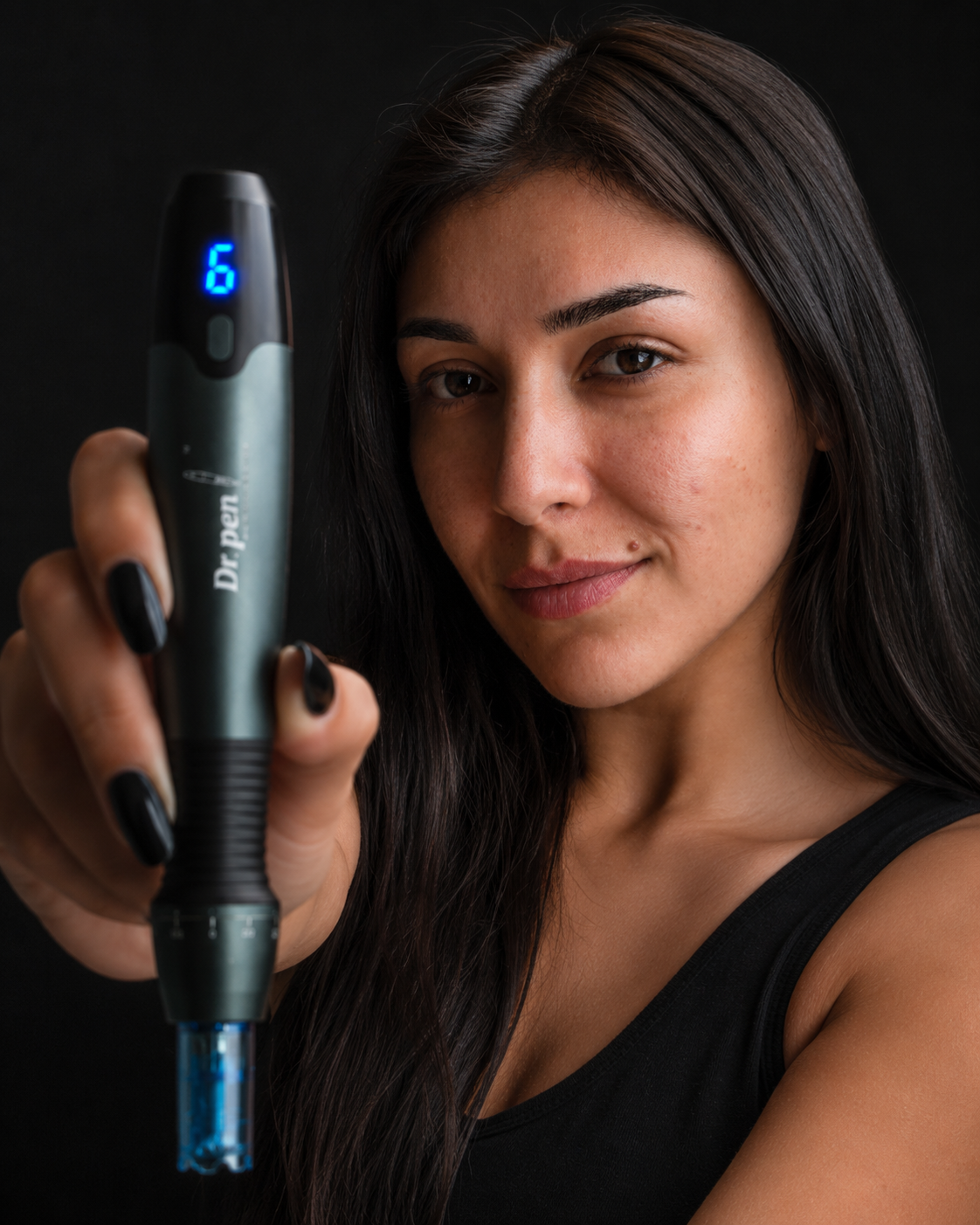
Most Dr. Pen handpieces use a continuous rotating collar that you turn until the marking lines up. The A20 replaces that with nine discrete positions from 0 to 2.0mm in 0.25mm increments, shown on an LED digital display. You do not approximate a depth — you select one, and it is the same selection every time you return to it.
That sounds like a small distinction until you are eight weeks into a course of work on an area of scarring. A dial set "at about 1.5" on the first visit and "at about 1.5" on the fourth is not necessarily set at the same place twice, and when you are judging whether an area is responding, the setting needs to be the constant rather than the variable. Fixed steps remove that ambiguity. Our piece on A20 depth settings goes through each step and what it is generally used for.
AVOS vertical oscillation
AVOS is Dr. Pen's name for the A20's vertical oscillation system: the needle module travels straight up and down along its axis rather than drifting laterally. That governs how tidy each channel is at entry and exit. It is a mechanical refinement rather than a headline feature, and one reason the A20 feels different in the hand from the pens beneath it.
The widest cartridge range we stock
The A20 platform takes 12, 14, 18, 24, 36 and 42 pin cartridges, plus a nano square tip — a spread that lets one handpiece move between fine detail work and broader coverage. Cartridges use a three-lock connection with an anti-backflow interface, and they seat firmly.
One point on compatibility: Dr. Pen builds each cartridge to match a specific handpiece — A20 cartridges fit the A20, M8 cartridges fit the M8, and so on. Choosing a device means choosing the cartridge platform you will live with, which is a bigger commitment than it first appears.
Cordless with a charging dock
The A20 runs on a 700mAh battery, charges over Type-C, and sits on a charging dock between uses. Through a day of appointments that matters: the pen has a home, and it is charged when you reach for it. For someone using a pen once a fortnight at the bathroom mirror, a dock is a nicety rather than a reason to spend more.
The A20 also holds FDA 510(k) clearance. That phrase deserves precision: clearance means the device was found substantially equivalent to a legally marketed predicate device. It is not the same as FDA approval, and the two words should not be used interchangeably.
Who the A20 is genuinely right for
- You treat clients. If other people are paying for your time, repeatability is not a luxury: you need notes that mean something across appointments and a cartridge range wide enough that you are not turning work away. The dock and battery life carry a working day.
- You are on a long, structured course. Scarring and pigmentation work is measured in months, not sessions. When the whole plan depends on holding one variable steady while you observe the result, fixed depth steps earn their keep in a way they simply do not for occasional use.
- You are upgrading, and you know why. People moving up from a cheaper pen usually arrive with a specific complaint: they cannot reproduce a setting, or they want a cartridge their current platform does not offer. That is the clearest signal the A20 will feel like an upgrade rather than a sideways move.
If you recognise yourself in one of those three, the A20 is a well-judged purchase and our full A20 review covers how it handles in more detail.
Who should buy something else
This is the part most shops leave out. There are three situations where the A20 is not the device we would put in your hands.
You are a first-time home user treating your own face occasionally
If the honest description of your use is "my own face, every three or four weeks, at home", the Dr. Pen M8 does that job. It has six speed levels, a 0–2.5mm continuous dial, around four hours of battery, and it ships with two 16-pin cartridges. It is our lowest-priced device and it takes the cheapest cartridges of any platform we stock — which, over a couple of years, is the number that actually decides what your microneedling costs you.
Nine fixed steps solve a problem occasional users rarely have. If you are treating the same face at roughly the same setting every few weeks, a dial is entirely adequate, and what you save on the handpiece and on every cartridge afterwards is better spent on aftercare and a good moisturiser. If you would like everything in one box, the M8 starter kit is the simplest way in.
Your main use is body work on thick skin
The A20 tops out at 2.0mm. That is ample for facial work, but body areas — stretch marks in particular — are frequently worked above that, and 2.5mm is a common requirement. The A20 cannot reach it.
If most of your planned work is on the body, the devices with a 0–2.5mm continuous dial are the sensible choice: the M9 or A11 for professional use, or the M8 at home.
You are buying primarily for hair loss
Scalp and hair-loss routines have their own conventions, and the M8S is the device most often bought for them. It has a 0–2.5mm dial and costs a fraction of the A20. If the scalp is the reason you are shopping at all, the A20's fixed steps and wide cartridge range are features you would be paying for and not using. Our M8 vs M8S comparison sets the two side by side.
None of the above is a criticism of the A20, and none of it is a criticism of you for considering it. It is simply that a device built around repeatability is worth its cost to someone who needs to repeat things, and worth rather less to someone who does not. There is no prize for owning the most advanced pen in the range if a simpler one does your work.
Why RPM is not a quality ranking
Speed figures are the easiest specification to compare, so they carry more weight in buying decisions than they deserve. The A20 runs at six speed levels up to 7,700 RPM. The M8 runs at six speed levels up to 18,000 RPM — more than twice as fast — and the M8 is our lowest-priced device. If RPM were a ranking of quality, the range would be ordered the other way round, and it plainly is not.
Speed governs how many passes cover an area at a given glide rate, and how the pen feels while you work. Depth, needle count and control govern what the treatment actually is. Read speed as a handling characteristic, and depth control as the thing that separates the models.
The total cost picture
The handpiece is the visible cost. It is rarely the larger one.
Cartridges are single use — a fresh sterile cartridge per person, per session, discarded afterwards. No cleaning routine makes it sound practice to sterilise and reuse one. Across two years of regular treatments, most people spend more on cartridges than they ever spent on the pen, and the gap widens the more you treat.
The consequence is that choosing a device is really choosing a consumables platform, and it deserves the same attention you would give the handpiece specification. Because Dr. Pen builds cartridges to match a specific handpiece, the platform you pick is the one you are restocking from for as long as you own the pen. The M8 platform has the cheapest cartridges of any range we stock. The A20 platform has the widest selection — and on the A20 our customers most often reorder the 12-pin cartridges, which handle most routine facial work.
- Estimate your sessions per year, then multiply by two.
- Check what a cartridge costs on the platform you are considering.
- Compare that running total against the difference between the two handpieces you are weighing up. It often reverses the answer.
Current pricing is on each product page.
Situation to recommended model
| Your situation | We would suggest | Why |
|---|---|---|
| First pen, own face, occasional home use | M8 or the M8 starter kit | Lowest-priced device, cheapest cartridges, 0–2.5mm dial covers home routines |
| Treating paying clients | A20 | Fixed steps make notes repeatable; widest cartridge range; dock suits a working day |
| Months-long course on scarring or pigmentation | A20 | Returning to an identical setting is the whole point of nine fixed depth steps |
| Mainly scalp and hair-loss work | M8S | The model most often bought for this; 0–2.5mm dial, far less outlay than the A20 |
| Body work, stretch marks, thicker skin | M9, A11 or M8 | 0–2.5mm continuous dial; the A20 stops at 2.0mm |
| General professional use, mixed face and body | M9 or A11 | Professional build with the depth range body work asks for |
| Upgrading because you cannot reproduce a setting | A20 | This is precisely the problem the fixed-step design was built to solve |
If your situation is not on that list, our guide to choosing the right Dr. Pen device works through it from first principles, and all models compared puts the specifications side by side.
What comes in the A20 kit
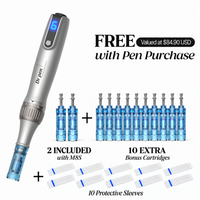
- A20 handpiece with LED digital display
- Charging dock
- Two 14-pin cartridges
- Charging cable and adapter
- Ten protective sleeves
- User guide
Two cartridges will not carry you far, so most people order a pack alongside the device; which pin count depends on the work.
Frequently asked questions
Is the Dr. Pen A20 worth it for home use?
For most home users, the M8 is the better fit. The A20's advantages — nine fixed depth steps for exact repeatability, the widest cartridge range, a charging dock — matter most when you are treating others or running a long structured course. If you are treating your own face every few weeks, the M8 does that job at a fraction of the price and with cheaper cartridges. The A20 becomes worth it at home when you are working through a months-long plan on scarring or pigmentation and need the same setting each time.
What is the maximum depth of the Dr. Pen A20?
2.0mm. The A20 offers nine fixed steps from 0 to 2.0mm in 0.25mm increments. It does not reach 2.5mm, which is why we point people whose main use is body work or stretch marks towards the M9, A11 or M8, all of which have a 0–2.5mm continuous dial.
Is the A20 faster than the M8?
No. The A20 has six speed levels up to 7,700 RPM; the M8 has six speed levels up to 18,000 RPM, more than twice as fast, and the M8 is our lowest-priced device. RPM is a handling characteristic rather than a quality ranking — the A20 sits above the M8 for its depth control and cartridge range, not its speed.
Can I use M8 or M8S cartridges with the A20?
No. Dr. Pen builds each cartridge to match a specific handpiece — A20 cartridges fit the A20, M8 cartridges fit the M8, and so on. Because cartridges are single use and are bought repeatedly, the platform you choose has a long tail of cost attached to it, so it is worth weighing when you pick the device.
What does AVOS mean on the A20?
AVOS is Dr. Pen's vertical oscillation system. The needle module travels straight up and down along its axis rather than drifting laterally, which keeps each channel tidier at entry and exit. It is one of the mechanical differences between the A20 and the pens below it in the range.
Is the Dr. Pen A20 FDA approved?
The A20 holds FDA 510(k) clearance, which is not the same as FDA approval. Clearance means the device was found substantially equivalent to a legally marketed predicate device. The distinction matters, and the two terms should not be used interchangeably.
Which A20 cartridge should I order first?
A20 cartridges come in 12, 14, 18, 24, 36 and 42 pin, plus a nano square tip. Our customers most often reorder the 12-pin, which suits most routine facial work. The kit includes two 14-pin cartridges to start you off, and higher pin counts are generally chosen for broader coverage.
Which Dr. Pen is best for hair loss?
The M8S is the model most often bought for scalp and hair-loss work. It has a 0–2.5mm dial and costs considerably less than the A20. If hair loss is your main reason for buying a pen, the A20's fixed steps and wide cartridge range are features you would be paying for without using them.
Specifications reflect current Dr. Pen documentation for the models we stock as an authorised stockist. Current pricing is on each product page.
Please speak with your doctor before purchasing any Dr. Pen product. This content is not intended to substitute for the advice of a qualified physician, pharmacist or other licensed healthcare professional.