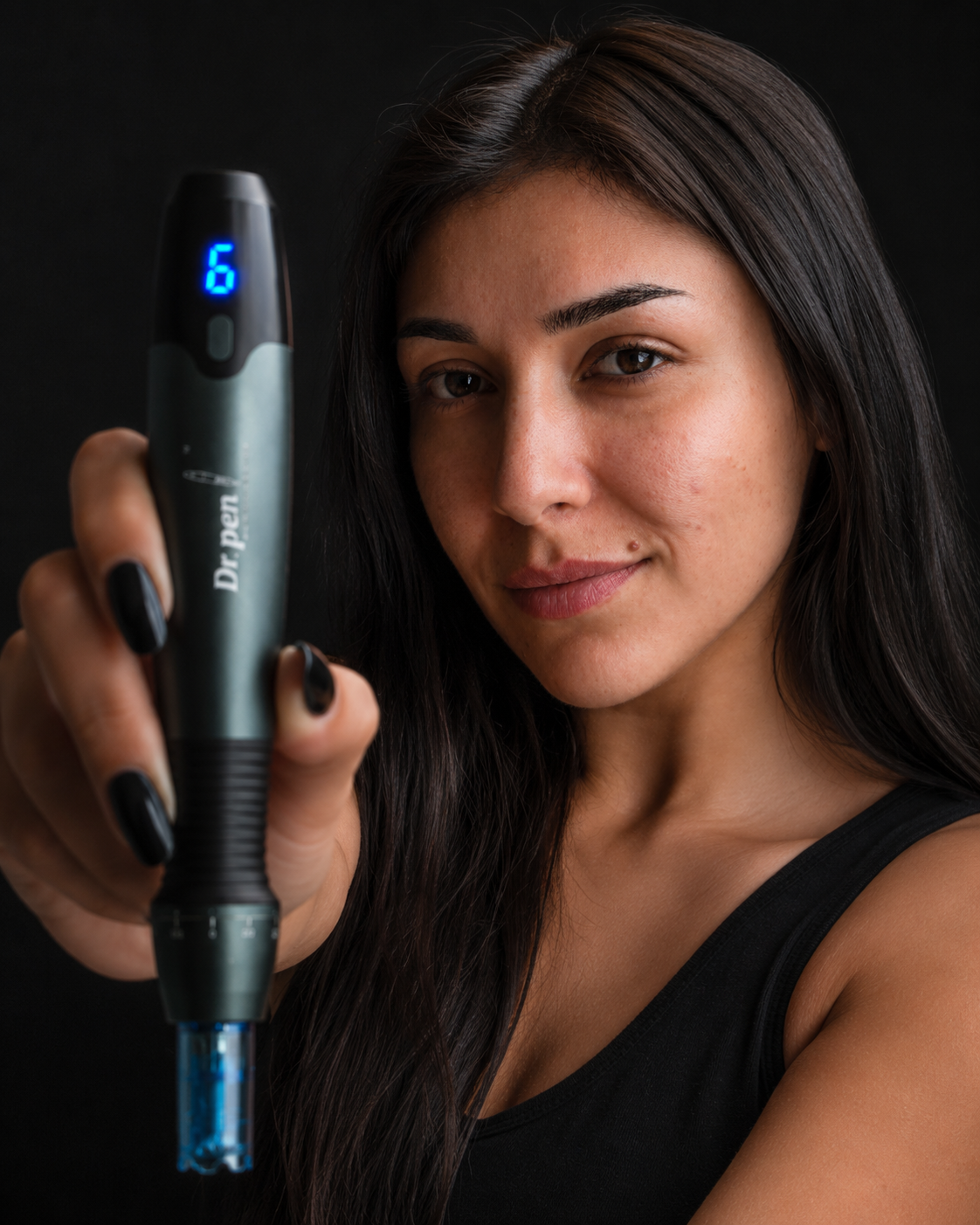
The short answer
The Dr. Pen A20 takes seven cartridge types: 12, 14, 18, 24, 36 and 42 pin, plus a nano square. Fewer pins concentrate the work and suit precise, targeted treatments; higher counts cover ground faster on large areas. The nano square carries no needles at all, using a silicone micro-textured tip for surface work and serum absorption. Every cartridge is single use, and A20 cartridges are built for the A20 specifically. If you are ever unsure, send us a photo of your pen and we will confirm which cartridges fit.
Most people research the pen carefully — motors, depth ranges, demonstrations — then treat the cartridges as an afterthought.
We have been an authorised Dr. Pen stockist for seven years, and the pattern we notice most is this: the handpiece is bought once, the cartridges for the life of the pen. Over two years of regular use, the cartridges quietly outspend the device that drives them. They are also the only part that touches skin, the only part that determines what a pass actually does, and the only part thrown away afterwards — which makes the platform worth understanding properly.
This guide covers all seven A20 cartridges, what each is good at, and the practical questions that come up after a few months with the pen. If you are still deciding on the device itself, our A20 review covers the handpiece.
The part you buy once, and the part you buy for years
The A20 is durable equipment: a 700mAh battery with Type-C charging and its own dock, six speed levels up to 7,700 RPM, AVOS vertical oscillation so needles travel straight in and out rather than dragging sideways, nine fixed depth steps from 0 to 2.0mm in 0.25mm increments on an LED digital display, and FDA 510(k) clearance. Looked after, it lasts.
The cartridges do not last, by design. Each is a sterile, sealed, single-use component. Treat your face regularly and you will move through a meaningful number in a year; add a second area and that number climbs. The device is a one-time decision; the cartridges are a decision you keep making, which is why it pays to make it well. Happily, it is not complicated once the seven options sit side by side.
The A20's three-lock connection and anti-backflow interface
The A20 uses a three-lock cartridge connection. Rather than a single point of contact, the cartridge seats and secures at three points, keeping it aligned with the drive shaft so it cannot work loose while the motor oscillates at speed. A cartridge that shifts mid-pass does not deliver a consistent depth, so the connection affects how even your results are.
The A20 also has an anti-backflow interface. Serum, blood and interstitial fluid are all present at the tip, and the design resists that fluid travelling back into the cartridge housing and handpiece body — a matter of hygiene and of the device's working life, since fluid inside a motor housing is a problem no external cleaning solves.
Anti-backflow protection is a feature across Dr. Pen's current professional handpieces, not a distinguishing feature of any single model — the A20 has one, and so do its stablemates. Where the models genuinely differ is in connection geometry, which is why cartridges are model-specific.
All seven A20 cartridges compared
Coverage per pass describes how much skin a single stroke addresses; depth pairing, the part of the A20's 0 to 2.0mm range each cartridge is most often used within. Depth is always a judgement, so read these as starting points — our depth settings guide covers the reasoning behind each step.
| Cartridge | Pins | Coverage per pass | What it suits | Typical depth pairing |
|---|---|---|---|---|
| 12 pin | 12 | Narrowest — a concentrated cluster | Individual scars, isolated marks, small stubborn patches, work close to the nose and mouth | Often the deeper half of the range, 1.0–2.0mm, on body scar work |
| 14 pin | 14 | Narrow, slightly wider footprint than the 12 | The general-purpose choice; facial work and contours, and the cartridge the A20 kit ships with | 0.25–1.0mm on the face, higher on the body |
| 18 pin | 18 | Moderate | A step up in speed, still manageable on cheeks, forehead and jawline | 0.25–1.0mm facial |
| 24 pin | 24 | Wide | Full-face sessions with fewer passes; larger flat planes | 0.5–1.25mm typically |
| 36 pin | 36 | Broad | Body areas — neck, décolletage, upper arms, thighs — and large uniform zones | 0.5–1.5mm depending on the area |
| 42 pin | 42 | Broadest needle option | The largest areas, such as the back, where pass count would otherwise be high | 0.5–1.5mm on body |
| Nano square | None — silicone tip | Even, surface-level | Serum absorption, surface texture, sensitive skin, frequent light sessions | Lowest steps only, 0–0.25mm |
Depth pairings above are orientation, not a treatment plan. Area, skin condition and individual tolerance all change the answer.
When a lower pin count beats a higher one
It is natural to read the table top to bottom and assume the 42 pin is the most capable, with everything above it a compromise. In practice, pin count is not a quality ladder. It is a footprint.
A 12 pin cartridge concentrates the same motor action into a small cluster, which is exactly what you want when the target is small. Along a single acne scar, an isolated stretch mark or the fine skin beside the nostril, a wide cartridge treats a great deal of skin that did not need treating in order to reach the bit that did. The narrow cartridge places the work where it belongs.
The other advantage is control. A smaller footprint keeps full contact on curved surfaces and makes it easier to hold the pen perpendicular to the skin — which is what keeps depth consistent.
Something that surprises people: among our A20 customers, the 12 pin and 14 pin are reordered most often. The assumption going in is usually that more needles must mean a better cartridge, and the reorder pattern quietly says otherwise — most people settle on precision for the face and keep the broad cartridges for the body.
A sensible mix: one narrow type as your default, one broad type for whichever body area you treat, and a nano square pack for the sessions between.
The nano square, explained
The nano square is the one option in the range that is not a needle cartridge at all, and the name causes confusion.
Instead of stainless steel pins, it carries a silicone tip formed into a fine micro-textured surface. It does not create the microchannels a needle cartridge does; it works at the very surface, briefly disturbing the outermost layer so a serum applied afterwards has an easier route in. Absorption is the point — a delivery and surface-conditioning tool rather than a remodelling one.
Because it stays superficial, it is the gentlest option and the one that can be repeated far more often — many people run a nano square on an every-second-day rhythm during a serum course, leaving longer gaps around their needle sessions. It also suits reactive skin and anyone easing into a routine.
On the A20 it belongs at the lowest depth steps, which the 0.25mm increments make easy to set precisely. For the fuller comparison, see micro needles versus nano needles.
Why cartridges are single use
There are two independent reasons, and either alone would be enough.
The first is sterility. A cartridge arrives sealed and sterile. After a session it has been in contact with blood and interstitial fluid, inside a housing with recesses no home cleaning method reaches reliably. Alcohol on the outside does not sterilise the inside, and the surfaces that matter are the ones you cannot see.
The second is mechanical, and it is the one people find more persuasive. Microneedles are extremely fine, and that fineness is what lets them pierce cleanly. Across a session the tips blunt. A blunt needle no longer makes a clean puncture — it tears, dragging the skin as it enters rather than parting it. That means more surface trauma for less useful effect, more discomfort during the session, and a slower recovery afterwards. A cartridge on its second outing does a rougher job than a fresh one, even when it looks identical.
- One cartridge, one person, one session — then it is done.
- An opened but unused cartridge has lost its sterile seal, so it is best treated as used.
- Sharps go into a sharps container, not a household bin.
- If a needle looks bent or uneven out of the packet, set it aside and start a fresh one.
Thinking about how many you will use in a year
Start with session frequency. Needle sessions on the face are commonly spaced across several weeks to allow recovery, so work out how many that gives you over twelve months, then add any second area — a neck, a décolletage, a scar worked on across a course of months. A separate area usually means a separate cartridge in the same sitting rather than a shared one.
Then add nano square sessions, which sit on a different rhythm entirely: being superficial, they can run every second day during a serum course, and that adds up. A small buffer is worth keeping too, so a cartridge you set aside for looking wrong does not cost you a session.
Cartridges come in packs of ten, which makes the arithmetic straightforward once you know your rhythm. Current pricing is on each product page.
Compatibility: which cartridges fit the A20
Dr. Pen builds each cartridge to match a specific handpiece — A20 cartridges fit the A20, M8 cartridges fit the M8, and so on. The connection geometry, the seating depth and the anti-backflow interface are matched to the model they were designed for, so a cartridge from another model is not a tighter or looser fit; it is a different fitting. Forcing an approximate match brings inconsistent depth, a cartridge that unseats mid-pass, and needless strain on the drive shaft.
Not certain which model you have in front of you? Send us a photo of your pen and we will confirm which cartridges fit before you order. We would far rather answer that message than have a pack arrive that does not suit your device.
Spotting a counterfeit cartridge
Because cartridges are a repeat purchase, they attract counterfeits — a genuine concern rather than a marketing line. The needles may not be medical-grade steel, the packaging may be decorative rather than functional, and the depth reached may not match what the pen is set to.
- Packaging: genuine cartridges arrive individually sealed, with clean printing, correct spelling and consistent branding.
- The needle array: pins uniform in length, evenly spaced and straight, with no splayed or shortened outliers.
- The fit: a genuine A20 cartridge seats positively into the three-lock connection, with no wobble and no force needed.
- The source: an authorised stockist is the simplest safeguard, because the supply chain is traceable.
- Genuine Dr. Pen devices carry a code on the box that can be checked through Dr. Pen's manufacturer security-verification system — worth doing when your pen arrives.
Storage and handling
A few habits keep cartridges in the condition they left the factory in.
- Keep them sealed until the moment of use — the packaging is what maintains sterility.
- Store cool, dry and out of direct sunlight; a shelf above a shower is a humid home for a sterile pack.
- Keep them flat rather than loose in a drawer where the tips can be knocked.
- Handle the cartridge by its body, fingers away from the needle end.
- Use the ten protective sleeves included in the A20 kit to keep the handpiece clean between passes.
The A20 kit ships with two 14-pin cartridges, the charging dock, cable and adapter, ten protective sleeves and a guide — enough for a first session or two, after which most people choose their ongoing mix. Our step-by-step guide to using the A20 walks through a full session, and the troubleshooting guide covers what occasionally comes up.
Frequently asked questions
How many cartridge types does the Dr. Pen A20 use?
Seven: six needle cartridges — 12, 14, 18, 24, 36 and 42 pin — and the nano square, which uses a silicone micro-textured tip rather than needles. All are sold in packs of ten.
Which A20 cartridge should I start with?
Most people start with the 14 pin, which the A20 kit includes. It is a good general-purpose footprint for facial work and gives you a reference point before deciding whether you want something narrower for precision or broader for the body.
Do more pins mean better results?
Not inherently. Pin count changes the footprint of each pass, not the quality of the treatment. Higher counts cover large areas in fewer passes; lower counts concentrate the work and give better control on small or curved areas. Among our A20 customers, the 12 pin and 14 pin are reordered most often.
Can I use a cartridge more than once?
Cartridges are designed for a single use. Sterility cannot be restored at home, and the tips blunt during a session — a blunt needle tears rather than piercing cleanly, meaning more surface trauma and a less comfortable recovery.
Will cartridges from another Dr. Pen model fit my A20?
Dr. Pen builds each cartridge to match a specific handpiece — A20 cartridges fit the A20, M8 cartridges fit the M8, and so on. If you are ever unsure which model you have, send us a photo of your pen and we will confirm which cartridges fit.
What is the nano square cartridge for?
It has no needles. A silicone micro-textured tip works at the skin's surface to help serums absorb, so it suits gentle, frequent sessions — often every second day during a serum course — as well as sensitive skin and the weeks between needle sessions.
What depth should I pair with each cartridge?
The A20 offers nine fixed steps from 0 to 2.0mm in 0.25mm increments. Facial work generally sits in the lower part of that range, body and scar work higher, the nano square at the lowest steps. Area, skin condition and tolerance all matter, so our depth settings guide holds the detail.
How do I know my cartridges and pen are genuine?
Buy from an authorised stockist, check that packs arrive individually sealed with even, straight needle arrays, and confirm the cartridge seats cleanly into the three-lock connection. Genuine Dr. Pen devices can be authenticated through Dr. Pen's manufacturer security-verification system using the code on the box. Our cartridge guide covers the wider range.
Choosing your mix
Choose the cartridge to fit the area, not the ambition: a narrow cartridge on a scar, a broad one on a back, a nano square on the days between, and the same well-maintained A20 handpiece driving all of them. Current pricing is on each product page, and we are glad to advise on which packs suit your routine.
Please speak with your doctor before purchasing any Dr. Pen product. This content is not intended to substitute for the advice of a qualified physician, pharmacist or other licensed healthcare professional.